
Northern Arizona’s Mountain Living Magazine, September 2017
Written by Gail Collins
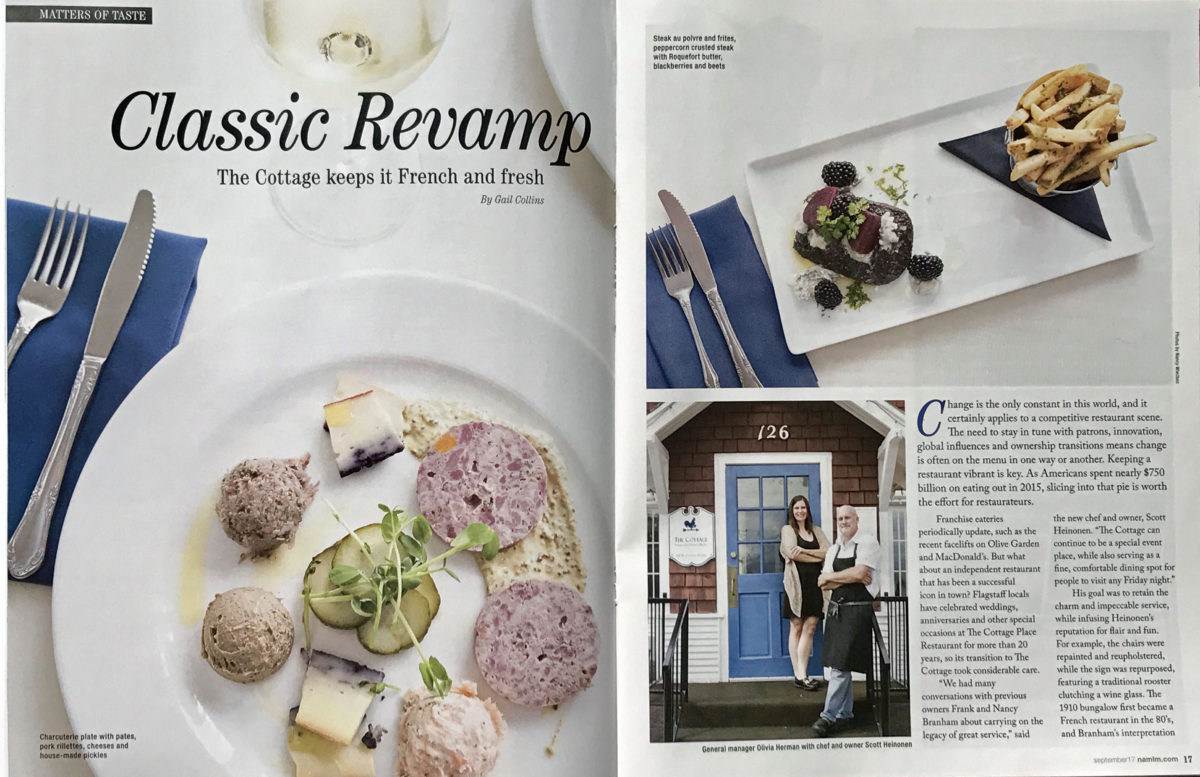
Change is the only constant in this world, and it certainly applies to a competitive restaurant scene. The need to stay in tune with patrons, innovation, global influences and ownership transitions mean change is often on the menu in one way or another. Keeping a restaurant vibrant is key, presenting opportunities for a restaurant revamp. As Americans spent nearly $750 billion on eating out in 2015, slicing into that pie is worth the effort for restaurateurs.
Franchise eateries periodically update, such as the recent facelifts on Olive Garden and MacDonald’s. But what about an independent restaurant that has been a successful icon in town? Flagstaff locals have celebrated weddings and hallmark anniversaries and other special occasions at The Cottage Place Restaurant for more than twenty years, so its transition to The Cottage took considerable care.
“We had many conversations with previous owners Frank and Nancy Branham about carrying on the legacy of great service,” said new owner and chef Scott Heinonen. “The Cottage can continue to be a special event place, while also serving as a fine, comfortable dining spot for people to visit any Friday night.”
His goal was to retain the charm and impeccable service, while infusing Heinonen’s reputation for flair and fun. For example, the chairs were repainted and reupholstered, while the sign was repurposed, featuring a traditional rooster clutching a wine glass. The 1910 bungalow first became a French restaurant in the 80’s, and Branham’s interpretation of French cuisine came a decade later. Now, Heinonen imparts his style, in a concise, evolving menu of French standards with updated taste trends.
 January/February 2016
 In a complicated, crowded world, it is easy to see why KISS—or Keep It Simple Sweetheart—is an ascending principle and a darn good way to start off the New Year. After seasonal trimmings, January offers the opportunity to strip away the unnecessary. Many people de-clutter or simplify aspects of their lives. Whether it is cleaning out closets or losing weight, the idea of getting back to basics or KISS, is attractive indeed.
 We often hear the cliché: There is strength in diversity. But what does that mean? When it comes to heritage farms, it can be the difference between life and death. In 1845, the Irish potato crop suffered blight. The bulk of farmers had planted only one type of potato, and over six years, a million people starved and another million left Ireland. This is the danger of industrial agriculture, which utilizes few breeds or crops to maximize output under specific conditions. Here is the bottom line on factory farming: 60 percent of beef is Angus, Hereford and Simmental breeds; 75 percent of pork comes from three breeds; and four breeds of sheep make up 60 percent of the market with a whopping 40 percent of that number as Suffolk. In the last 15 years, 200 breeds of animals have become extinct worldwide. Genetic diversity is essential to a healthy food supply to withstand harsh conditions and unforeseen circumstances.